

Why Rocket Money Doesn't Work in the UK
Rocket Money (formerly known as Truebill) is built entirely on the US financial infra. It uses Plaid to connect to American bank accounts and credit cards, which means subscription detection, bill negotiation, and cancellation concierge features simply don't function outside of the United States.
There's no UK version of Rocket Money, and Rocket Companies hasn't signalled plans to expand internationally. This is mostly a business decision as the US market is large and all their cancel infra is built around the US market.
This is similar across popular US subscription management apps such as Hiatus and Trim that also rely on US-only bank integrations and aren't accessible to anyone banking in the UK.
This leaves UK users in a frustrating position. You're aware that your subscription creep is an issue, and the average UK household now spends over £60 per month on streaming services alone, before counting gym memberships, software tools, and the growing list of AI apps with monthly fees. But the biggest apps don’t service you.
The good news is that the UK has its own banking data framework, and it's arguably more advanced than what exists in the US, which opens up doors for tools.
UK Open Banking Opens up a Lot of Doors
The UK was actually one of the first countries in the world to roll out Open Banking, starting back in 2018. Regulated by the Financial Conduct Authority (FCA).
UK Open Banking is a framework that allows third-party apps to securely access your banking transaction data with your explicit consent, using read-only connections. That means the app can see your spending, but it can't move your money.
This is the same kind of technology that powers Rocket Money in the US (through Plaid), but the UK version is more standardised and more tightly regulated. The result is that several UK-based apps can now connect to all major high street banks, Barclays, HSBC, Lloyds, NatWest, Santander, Monzo, Starling, and more, to automatically detect subscriptions and transactions.
The challenge has been that most UK apps have focused primarily on budgeting and spend analysis, treating subscription tracking as a secondary feature rather than the main product. That's starting to change, but it's worth understanding these differences when choosing the right tool.
Quick Comparison: Rocket Money UK Alternatives
App | Type | UK Bank Support | Subscription Tracking | Cancellation Help | Budgeting | Price | Best For |
Emma | Auto (Open Banking) | ✅ Excellent | ✅ Strong detection | Limited | Advanced | Free - £14.99/mo | Feature-rich budgeting with subscription visibility |
Snoop | Auto (Open Banking) | ✅ Excellent | ✅ Bill detection | ❌ | Moderate | Free - £4.99/mo | Smart money-saving tips and bill switching |
Moneyhub | Auto (Open Banking) | ✅ Excellent | ✅ Via categories | ❌ | Advanced | £1.49/mo | Deep financial planning and net worth tracking |
Plum | Auto (Open Banking) | ✅ Excellent | ⚠️ Basic | ❌ | Moderate | Free - £9.99/mo | Automated saving and investing |
PocketSmith | Auto + Manual | ✅ Via Basiq | ⚠️ Via categories | ❌ | Advanced | Free - £16/mo | Long-term forecasting and multi-currency |
Bobby / Subby | Manual | N/A (no bank sync) | ✅ Dedicated | ❌ | ❌ | £3 one-time | Privacy-first manual tracking |
Orbit Money | Auto + Manual + Email | 🔜 Planned | ✅ Dedicated | ✅ Planned | Planned but not initially | Free. Will include premium tiers for advanced features | Dedicated subscription management for UK and global users |
UK Budgeting Apps With Subscription Tracking
These are the apps that UK users are most likely to come across when searching for Rocket Money alternatives. They all connect to UK banks through Open Banking and offer some level of subscription visibility, but their primary focus is broader money management.
Emma App
Emma is probably the closest thing the UK has to Rocket Money, in terms of ambition and available features. Founded by two Italian entrepreneurs in London, Emma connects to your UK bank accounts and credit cards to provide a unified view of your spending, subscriptions, balances, and investments.
Where Emma genuinely stands out is subscription detection. It automatically identifies recurring subscriptions across your connected accounts and shows them in a dedicated monthly and annual view, with price change alerts. If you've got subscriptions scattered everywhere, Emma can show them all in one place.
Beyond subscriptions, Emma also offers budget tracking, net worth monitoring, crypto and stock tracking, bill splitting, cashback rewards (UK only), and rent reporting for credit building. It's an all-in-one financial app.
So what’s the tradeoff? Emma's aggressive monetisation strategy has frustrated a lot of users. The free tier is fairly limited, and the app regularly prompts you to upgrade.
There are also recurring complaints about free trial billing issues and difficulty cancelling the premium subscription, which is ironic for an app that helps you track subscriptions.
Emma also cannot cancel subscriptions on your behalf, which is one area where it falls short compared to what Rocket Money offers in the US.
Pricing: Free plan available. Emma Plus £4.99/mo, Emma Pro £9.99/mo, Emma Ultimate £14.99/mo.
Best for: UK users who want a visually polished money management app that combines subscription tracking with deeper budgeting, investment tracking, and cashback.
Read our full Emma App review for a deeper look at the features, pricing, and the controversies.
Snoop
Snoop is a UK-built money app that takes a slightly different approach to managing your money.
Rather than trying to be an all-in-one budgeting platform, Snoop focuses on proactively finding ways to save you money.
It connects to your bank accounts via Open Banking, scans your transactions, and then shows personalised suggestions, or "Snoops", for cheaper deals on broadband, mobile contracts, insurance, energy, and more.
For subscription management, Snoop detects regular payments and flags bills that have increased. It also sends contract renewal reminders, which is useful for catching those annual price hikes that slip through. It's not a dedicated subscription tracker, but it does a reasonable job of highlighting where your recurring spending might be higher than it needs to be.
Pricing: Free version is generous. Snoop Plus at £4.99/mo adds payday budgeting, custom reports, and net worth tracking.
Best for: UK users who want smart, actionable saving tips alongside basic subscription and bill visibility, without the clutter of a full budgeting system.
Moneyhub
Moneyhub is one of the more serious financial planning tools available to UK users. It connects to bank accounts, credit cards, savings, pensions, investments, and even property valuations to give you a full picture of your financial position. If your goal is understanding your entire net worth and long-term financial health, Moneyhub goes deeper than most competing apps.
For subscription tracking specifically, Moneyhub identifies recurring payments through transaction categorisation rather than offering a dedicated subscription dashboard. It works, but it's not as streamlined as Emma or a purpose-built subscription tracker. You won't get features like free trial alerts, price hike notifications, or cancellation guidance.
What sets Moneyhub apart is its business model. It charges a flat subscription fee (£1.49/mo) and doesn't sell user data or show ads. For users who are uncomfortable with free apps monetising their financial data, that transparency is worth something.
Pricing: £1.49/mo or £14.99/year after a 6-month free trial. No free tier beyond the trial.
Best for: UK users who want deep financial analysis, pension tracking, and long-term planning, with subscription visibility as a secondary benefit.
Plum
Plum is more of an automated savings and investing app than a subscription tracker, but it does connect to your UK bank accounts and provides spending analysis that includes subscriptions.
Plum's main feature is its AI-driven auto-saving, which analyses your income and spending patterns and automatically sets money aside in small amounts. It also offers ISAs, investment portfolios, and cashback deals. For subscription management, Plum can show you your regular bills and changes, but it doesn't offer a dedicated subscription view or any cancellation support.
Think of Plum as a tool for building savings habits rather than cutting subscription costs. If your goal is specifically to manage and reduce subscriptions, Plum isn't the right pick, but if you want a broader savings-first approach to money management, it's well designed and popular among UK users.
Pricing: Free version available. Plus £3.99/mo, Premium £9.99/mo.
Best for: UK users focused on automated saving and investing who also want basic spending visibility.
Manual Subscription Trackers That Work in the UK
Not every user wants to connect their bank accounts to a third-party app. Whether it's a privacy preference or simply a desire for more control, manual subscription trackers offer a clean alternative. These apps don't use Open Banking at all, you enter your subscriptions yourself and get reminders before payments are due.
Bobby (iOS) and Subby (Android)
Bobby and Subby are minimalist manual subscription tracking apps designed to do one thing well: give you a clear list of your recurring payments with cost totals and renewal reminders. Bobby is iOS-only, Subby is Android-only. Both work anywhere in the world, support multiple currencies including GBP, and don't require any account connections.
Because everything is manually entered, they'll never catch a forgotten subscription automatically. But for users who prefer full control and don't want any third party seeing their financial data, Bobby and Subby are some good options. They're also among the only subscription trackers that use a one-time purchase model rather than charging a monthly fee themselves.
Pricing: Free for limited subscriptions. One-time unlock of approximately £3–4.
Best for: Privacy-conscious UK users who want simple, manual subscription tracking without bank connections or ongoing fees.
TrackMySubs
TrackMySubs is a web-based manual subscription tracker built for freelancers, creators, and small businesses managing multiple SaaS tools. It doesn't connect to bank accounts and works globally, making it a viable option for UK-based self-employed users who need to track business subscriptions separately from personal ones.
The interface is functional but dated, and there's no mobile app. It's structured around folders, tags, and CSV import rather than the polished UX of consumer apps. For individuals tracking personal streaming services, it's overkill, but for UK freelancers managing a stack of business tools, it offers useful organisation features.
Pricing: Free for up to 10 subscriptions. Paid plans from roughly £5–15/mo.
Best for: UK freelancers and small business owners who need structured, manual tracking of SaaS and business subscriptions.
Upcoming: Orbit Money
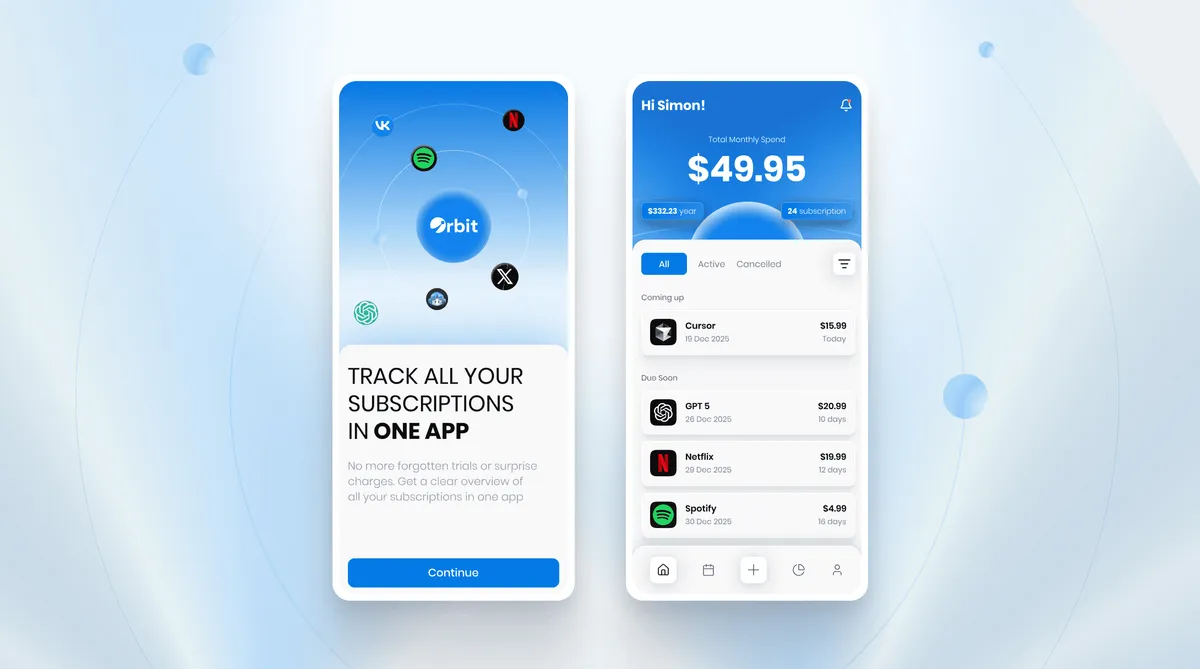
Orbit Money is a subscription management app currently in development that's being built with international markets, including Australia and the UK, as a core focus from day one.
Unlike the budgeting apps that treat subscription tracking as just a side feature, Orbit is being designed specifically around the subscription problem. The goal is to combine multiple detection methods, bank connection, email scanning, document upload, and manual entry, to give users a more complete picture of their recurring payments without forcing them to rely on a single method.
Orbit is also planning cancellation guidance and support, free trial tracking with pre-charge reminders, price hike alerts, deal matching for cheaper alternatives, and the ability to separate personal and business subscriptions. These are features that most UK apps currently lack, and that fill the gap left by Rocket Money's absence from the market.
UK Open Banking support is on Orbit's roadmap, which means it would connect to major UK banks through the same FCA-regulated framework used by Emma, Snoop, and Moneyhub. But the addition of email scanning and manual entry means users who don't want to connect their bank accounts would still get strong subscription visibility.
Pricing: Free, with premium plans planned.
Best for: UK users who want a purpose-built subscription management app, not a budgeting app with subscription features bolted on.
Learn more about Orbit Money or try Orbit.
Which Alternative Should You Actually Choose?
This depends on what you're actually trying to solve.
If you want the closest thing to Rocket Money in the UK currently: Emma is the strongest overall match. It has the best subscription detection of any UK budgeting app, connects to all major UK banks, and offers a wide feature set. Just be prepared for upgrade prompts and consider whether you're comfortable with the premium pricing.
If you want to save money on household bills: Snoop is the smartest pick. Its bill-switching suggestions and deal-finding features address a similar need to Rocket Money's bill negotiation, just through a different mechanism.
If you want automated saving with basic spending visibility: Plum is well designed and popular, though subscription tracking is a secondary feature.
If you want simple, private, manual tracking: Bobby (iOS) or Subby (Android) are the cleanest options with no bank connections required.
If you want a dedicated subscription management app: This is the gap in the UK market right now. No existing app is built specifically to manage subscriptions with features like free trial tracking, price hike alerts, cancellation assistance, and deal matching. Orbit Money is being built to fill exactly this gap, with the UK as a priority market.
See our full breakdown of top subscription tracker apps.
The UK Subscription Management Gap
There's a noticeable gap in the UK market for dedicated subscription management. American users have access to apps that are specifically designed to detect subscriptions, negotiate bills, cancel unwanted services, and track free trials. UK users mostly have budgeting apps that happen to detect some recurring charges as part of a broader financial overview.
This gap exists partly because UK Open Banking adoption among consumer apps has been slower than expected, and partly because most UK fintech startups have focused on the budgeting and savings angles rather than the specific subscription management problem.
But the demand is clearly there. Search data shows consistent and growing interest from UK users looking for tools like Rocket Money, subscription trackers, and ways to manage recurring payments. As more apps build dedicated subscription features for the UK Open Banking ecosystem, this gap should close.
If you want to be among the first to try a purpose-built subscription solution, Orbit Money is live and you can try it today.
FAQs
Is Rocket Money available in the UK?
No. Rocket Money only works with US-based bank accounts and financial institutions. Its subscription tracking, bill negotiation, and cancellation concierge features are not accessible to UK users. Read our full Rocket Money review for more details on how it works in the US.
What is the UK equivalent of Rocket Money?
There's no direct UK equivalent. Emma is the closest in terms of feature breadth, offering subscription detection alongside budgeting, investment tracking, and cashback. Snoop offers similar bill-switching features to Rocket Money's bill negotiation. For dedicated subscription management, Orbit Money is being built specifically to fill this gap in the UK market.
Can I track subscriptions without connecting my bank in the UK?
Yes. Apps like Bobby (iOS) and Subby (Android) let you manually track subscriptions without any bank connections. TrackMySubs is another option for business-focused tracking. Orbit Money is also planning email-based detection as an alternative to bank syncing.
Which UK subscription tracker is free?
Snoop offers a generous free plan with bank integration and bill tracking. Emma has a free tier but limits you to two bank connections. Money Dashboard (for existing users) is entirely free. Bobby and Subby use one-time purchase models. For a broader comparison, see our guide to the best subscription trackers.
Is it safe to connect my bank to a UK budgeting app?
Yes, provided the app uses FCA-regulated Open Banking. Apps like Emma, Snoop, Moneyhub, and Plum use read-only access, meaning they can view your transactions but cannot move money. Your bank login credentials are never stored by the app. Always verify an app's FCA registration before connecting financial accounts.
Do any UK apps cancel subscriptions for you?
Currently, no widely available UK app offers a subscription cancellation concierge service like Rocket Money does in the US. Most UK apps focus on detection and visibility rather than taking action on your behalf. Orbit Money is planning to include cancellation guidance and assistance as part of its launch.
What happened to Money Dashboard?
Money Dashboard was one of the original UK Open Banking budgeting apps. Its technology was acquired by Moneyhub, and the standalone Money Dashboard app closed to new public users in early 2025. Moneyhub continues to offer similar functionality at £1.49/mo.