

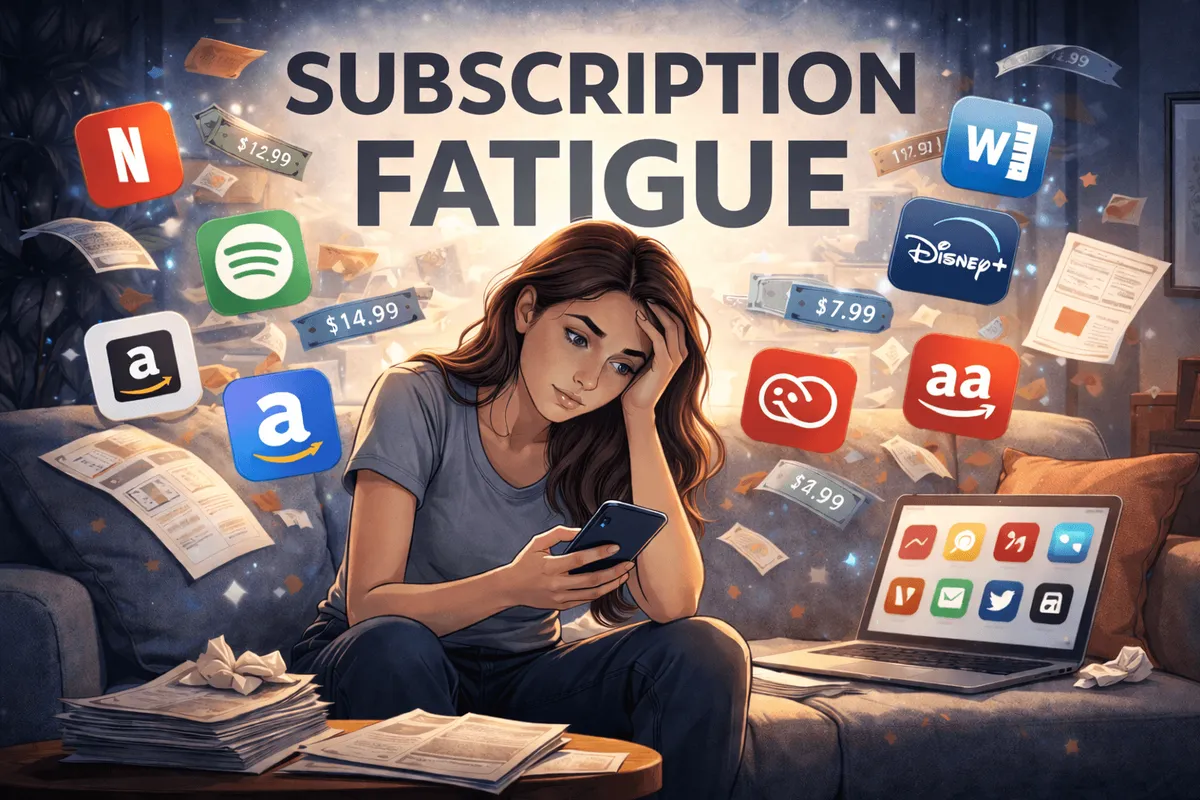
Subscription Fatigue

Thursday, January 8, 2026

Subscription Fatigue Explained: How Too Many Subscriptions Are Hurting Consumers

Simon Chadwick

Founder & CEO

In 2026, the subscription economy is everywhere. From entertainment and fitness to productivity and ai tools, nearly every product or service now asks us to subscribe to a monthly plan, rather than buy outright. 

While this model offers flexibility and lower-cost access upfront, it has also created a growing problem felt by both merchants and consumers: subscription fatigue.

Subscription fatigue happens when consumers feel overwhelmed and frustrated by the increasing number of subscription services competing for their attention, money, and mental energy.

Unlike simple spending concerns, this fatigue is emotional and mental. It’s the constant decision-making, the guilt of unused services, and the nagging sense that you’re not getting your subscriptions’ full value.

This shift isn’t anecdotal. Research from Deloitte in a 2024 report shows that consumers increasingly feel strained by recurring digital commitments, even when individual monthly fees seem manageable.

Over time, this strain builds into something deeper than budgeting, it becomes behavioral burnout, this then effect merchants and purchase behaviour. 

What Is Subscription Fatigue?

Subscription fatigue is the feeling of mental and emotional exhaustion that comes from managing one or more subscriptions across multiple different platforms.

It’s not just about having many subscriptions; it’s about the ongoing responsibility that comes with recurring payments all on different dates, free-trials, renewal decisions, and tracking your usage.

Many consumers feel overwhelmed because subscriptions don’t end naturally.
Once you subscribe, the burden shifts to you to remember, review, and cancel when something no longer serves you.

This dynamic is a textbook case of decision fatigue, a phenomenon widely studied in behavioral science, where repeated low-stakes decisions gradually erode user confidence and satisfaction.

Subscriptions across different services renew automatically, and users often delay making decisions to deal with them, until the frustration builds.

Why Subscription Fatigue Is Increasing

The Widespread Growth of Subscription Services

The subscription market has expanded rapidly over the past decade. What began with media and entertainment has spread to software, wellness, education, and physical goods like subscription boxes.

Today, consumers face an increasing number of subscription services, each promising more convenience and higher value.

According to the Zuora Subscription Economy Index, the global subscription economy has grown more than 500% over the last ten years.

While this growth has fueled innovation and business boom, it has also led to a crowded landscape of subscription offerings that many consumers struggle to evaluate.

The Subscription Model Shifts Responsibility from the Merchant to the User

The subscription model is an attractive business model because it generates predictable subscription revenue and a recurring revenue stream for merchants.

For subscription-based companies, this stability supports long-term planning and customer lifetime value.

For subscribers, however, it introduces ongoing cognitive load.

Unlike a one-time purchase, a subscription-based relationship requires regular reassessment.

 When managing multiple subscriptions becomes routine, services can become a burden rather than empowering.

Signs You’re Experiencing Subscription Fatigue

Many consumers don’t immediately recognize subscription fatigue. Common signs include:

  • Feeling overwhelmed and frustrated when reviewing bank statements

  • Ignoring cancellation or renewal emails

  • Forgetting why you subscribed

  • Cancelling impulsively, then re-subscribing later

  • Questioning whether you’re getting your money’s worth

  • Hesitation signing up to new trials or services you actually want and/or need.

Data from a consumer survey on susbcriptions shows that nearly half of subscribers have cancelled a subscription in the past year, often citing lack of use or unclear value rather than price alone.

Subscription Fatigue, Customer Experience and the Impacts on Merchants

From a business perspective, subscription fatigue directly impacts customer experience, acquisition retention rates, and churn.

The cost of acquiring new users gets driven up as users are more hesitant then ever signing up to new services. 

When consumers feel mentally drained, they are also more likely to cancel, even if the subscription service itself delivers quality.

Research from McKinsey highlights that churn is often driven less by pricing and more by friction: confusing tiers, rigid cancellation policies, and poor visibility into usage.
These factors reduce satisfaction with the subscription experience and weaken long-term loyalty.

A successful subscription business isn’t just about acquiring subscribers, it’s about communicating value and maintaining the customer relationship throughout the subscription lifecycle.

Businesses that benefit most from consumers forgetting about their subscriptions will face more challenges now the road. 

How Consumers Can Reduce Subscription Fatigue

To reduce subscription fatigue, consumers need systems, not discipline.

Helpful strategies include:

  • Centralizing subscription management and tracking. This can be done with spreadsheets or automated subscription trackers, see our comparison guide on top subscription trackers.

  • Reviewing subscriptions quarterly instead of reactively. Take a look at our subscription audit tool to find hidden subscriptions.

  • Aligning subscriptions with specific needs or seasons

  • Using reminders before renewal dates (either calendar or leveraging tools)

  • Limiting free trials to one or two at a time

  • Using virtual cards wisely for very control over your free trials

When people actively manage their subscriptions, they can see everything in front of them and they regain confidence and reduce the feeling of being overwhelmed.

Why Cancelling Everything Isn’t the Answer

When fatigue peaks, many consumers respond by cancelling their services  aggressively.

While this can provide temporary relief, it often leads to regret.
Users cancel one subscription only to resubscribe weeks later, restarting the cycle.

The issue isn’t the subscription-based model itself, it’s the lack of clarity and control.

Prevent subscription regret by focusing on intentional engagement rather than blanket elimination.

Systems are the key to ensuring your subscriptions don't bottle up to the point where you need to cancel them all in one hit.

If you do need to cancel subscriptions, our the Orbit cancel guide tool, make it easier to cancel unwanted subscriptions.

What Subscription-Based Companies Can Do Better

Subscription-based companies also play a role in reducing fatigue. Improving the subscription experience benefits both users and businesses.

Effective approaches include:

  • Flexible subscription tiers 

  • Easy, transparent cancellation

  • Clear usage summaries

  • Pause options instead of forced cancellation

  • Communicate value on an ongoing basis, relying on users forgetting will eventually lead to churn.

Companies that simplify the customer experience see higher retention rates, stronger customer lifetime value, and more sustainable subscription revenue over time.

The Future of the Subscription Economy

The global subscription economy will continue to grow, but its success depends on balance. As subscription services available increase, so does consumer demand for simplicity and transparency.

Many consumers are actively rethinking how they engage with apps and services.

Those who beat subscription fatigue won’t abandon subscriptions entirely, they’ll choose fewer, better-aligned ones and expect more respectful subscription offerings.

Subscription fatigue isn’t a rejection of subscriptions. It’s a signal that the model must evolve.

Orbit Money is building to help consumers better get ontop of their subscriptions and manage subscription fatigue.

Subscription Fatigue

Thursday, January 8, 2026

Subscription Fatigue Explained: How Too Many Subscriptions Are Hurting Consumers

Simon Chadwick

Founder & CEO

In 2026, the subscription economy is everywhere. From entertainment and fitness to productivity and ai tools, nearly every product or service now asks us to subscribe to a monthly plan, rather than buy outright. 

While this model offers flexibility and lower-cost access upfront, it has also created a growing problem felt by both merchants and consumers: subscription fatigue.

Subscription fatigue happens when consumers feel overwhelmed and frustrated by the increasing number of subscription services competing for their attention, money, and mental energy.

Unlike simple spending concerns, this fatigue is emotional and mental. It’s the constant decision-making, the guilt of unused services, and the nagging sense that you’re not getting your subscriptions’ full value.

This shift isn’t anecdotal. Research from Deloitte in a 2024 report shows that consumers increasingly feel strained by recurring digital commitments, even when individual monthly fees seem manageable.

Over time, this strain builds into something deeper than budgeting, it becomes behavioral burnout, this then effect merchants and purchase behaviour. 

What Is Subscription Fatigue?

Subscription fatigue is the feeling of mental and emotional exhaustion that comes from managing one or more subscriptions across multiple different platforms.

It’s not just about having many subscriptions; it’s about the ongoing responsibility that comes with recurring payments all on different dates, free-trials, renewal decisions, and tracking your usage.

Many consumers feel overwhelmed because subscriptions don’t end naturally.
Once you subscribe, the burden shifts to you to remember, review, and cancel when something no longer serves you.

This dynamic is a textbook case of decision fatigue, a phenomenon widely studied in behavioral science, where repeated low-stakes decisions gradually erode user confidence and satisfaction.

Subscriptions across different services renew automatically, and users often delay making decisions to deal with them, until the frustration builds.

Why Subscription Fatigue Is Increasing

The Widespread Growth of Subscription Services

The subscription market has expanded rapidly over the past decade. What began with media and entertainment has spread to software, wellness, education, and physical goods like subscription boxes.

Today, consumers face an increasing number of subscription services, each promising more convenience and higher value.

According to the Zuora Subscription Economy Index, the global subscription economy has grown more than 500% over the last ten years.

While this growth has fueled innovation and business boom, it has also led to a crowded landscape of subscription offerings that many consumers struggle to evaluate.

The Subscription Model Shifts Responsibility from the Merchant to the User

The subscription model is an attractive business model because it generates predictable subscription revenue and a recurring revenue stream for merchants.

For subscription-based companies, this stability supports long-term planning and customer lifetime value.

For subscribers, however, it introduces ongoing cognitive load.

Unlike a one-time purchase, a subscription-based relationship requires regular reassessment.

 When managing multiple subscriptions becomes routine, services can become a burden rather than empowering.

Signs You’re Experiencing Subscription Fatigue

Many consumers don’t immediately recognize subscription fatigue. Common signs include:

  • Feeling overwhelmed and frustrated when reviewing bank statements

  • Ignoring cancellation or renewal emails

  • Forgetting why you subscribed

  • Cancelling impulsively, then re-subscribing later

  • Questioning whether you’re getting your money’s worth

  • Hesitation signing up to new trials or services you actually want and/or need.

Data from a consumer survey on susbcriptions shows that nearly half of subscribers have cancelled a subscription in the past year, often citing lack of use or unclear value rather than price alone.

Subscription Fatigue, Customer Experience and the Impacts on Merchants

From a business perspective, subscription fatigue directly impacts customer experience, acquisition retention rates, and churn.

The cost of acquiring new users gets driven up as users are more hesitant then ever signing up to new services. 

When consumers feel mentally drained, they are also more likely to cancel, even if the subscription service itself delivers quality.

Research from McKinsey highlights that churn is often driven less by pricing and more by friction: confusing tiers, rigid cancellation policies, and poor visibility into usage.
These factors reduce satisfaction with the subscription experience and weaken long-term loyalty.

A successful subscription business isn’t just about acquiring subscribers, it’s about communicating value and maintaining the customer relationship throughout the subscription lifecycle.

Businesses that benefit most from consumers forgetting about their subscriptions will face more challenges now the road. 

How Consumers Can Reduce Subscription Fatigue

To reduce subscription fatigue, consumers need systems, not discipline.

Helpful strategies include:

  • Centralizing subscription management and tracking. This can be done with spreadsheets or automated subscription trackers, see our comparison guide on top subscription trackers.

  • Reviewing subscriptions quarterly instead of reactively. Take a look at our subscription audit tool to find hidden subscriptions.

  • Aligning subscriptions with specific needs or seasons

  • Using reminders before renewal dates (either calendar or leveraging tools)

  • Limiting free trials to one or two at a time

  • Using virtual cards wisely for very control over your free trials

When people actively manage their subscriptions, they can see everything in front of them and they regain confidence and reduce the feeling of being overwhelmed.

Why Cancelling Everything Isn’t the Answer

When fatigue peaks, many consumers respond by cancelling their services  aggressively.

While this can provide temporary relief, it often leads to regret.
Users cancel one subscription only to resubscribe weeks later, restarting the cycle.

The issue isn’t the subscription-based model itself, it’s the lack of clarity and control.

Prevent subscription regret by focusing on intentional engagement rather than blanket elimination.

Systems are the key to ensuring your subscriptions don't bottle up to the point where you need to cancel them all in one hit.

If you do need to cancel subscriptions, our the Orbit cancel guide tool, make it easier to cancel unwanted subscriptions.

What Subscription-Based Companies Can Do Better

Subscription-based companies also play a role in reducing fatigue. Improving the subscription experience benefits both users and businesses.

Effective approaches include:

  • Flexible subscription tiers 

  • Easy, transparent cancellation

  • Clear usage summaries

  • Pause options instead of forced cancellation

  • Communicate value on an ongoing basis, relying on users forgetting will eventually lead to churn.

Companies that simplify the customer experience see higher retention rates, stronger customer lifetime value, and more sustainable subscription revenue over time.

The Future of the Subscription Economy

The global subscription economy will continue to grow, but its success depends on balance. As subscription services available increase, so does consumer demand for simplicity and transparency.

Many consumers are actively rethinking how they engage with apps and services.

Those who beat subscription fatigue won’t abandon subscriptions entirely, they’ll choose fewer, better-aligned ones and expect more respectful subscription offerings.

Subscription fatigue isn’t a rejection of subscriptions. It’s a signal that the model must evolve.

Orbit Money is building to help consumers better get ontop of their subscriptions and manage subscription fatigue.

Subscription Fatigue

Thursday, January 8, 2026

Subscription Fatigue Explained: How Too Many Subscriptions Are Hurting Consumers

Simon Chadwick

Founder & CEO

In 2026, the subscription economy is everywhere. From entertainment and fitness to productivity and ai tools, nearly every product or service now asks us to subscribe to a monthly plan, rather than buy outright. 

While this model offers flexibility and lower-cost access upfront, it has also created a growing problem felt by both merchants and consumers: subscription fatigue.

Subscription fatigue happens when consumers feel overwhelmed and frustrated by the increasing number of subscription services competing for their attention, money, and mental energy.

Unlike simple spending concerns, this fatigue is emotional and mental. It’s the constant decision-making, the guilt of unused services, and the nagging sense that you’re not getting your subscriptions’ full value.

This shift isn’t anecdotal. Research from Deloitte in a 2024 report shows that consumers increasingly feel strained by recurring digital commitments, even when individual monthly fees seem manageable.

Over time, this strain builds into something deeper than budgeting, it becomes behavioral burnout, this then effect merchants and purchase behaviour. 

What Is Subscription Fatigue?

Subscription fatigue is the feeling of mental and emotional exhaustion that comes from managing one or more subscriptions across multiple different platforms.

It’s not just about having many subscriptions; it’s about the ongoing responsibility that comes with recurring payments all on different dates, free-trials, renewal decisions, and tracking your usage.

Many consumers feel overwhelmed because subscriptions don’t end naturally.
Once you subscribe, the burden shifts to you to remember, review, and cancel when something no longer serves you.

This dynamic is a textbook case of decision fatigue, a phenomenon widely studied in behavioral science, where repeated low-stakes decisions gradually erode user confidence and satisfaction.

Subscriptions across different services renew automatically, and users often delay making decisions to deal with them, until the frustration builds.

Why Subscription Fatigue Is Increasing

The Widespread Growth of Subscription Services

The subscription market has expanded rapidly over the past decade. What began with media and entertainment has spread to software, wellness, education, and physical goods like subscription boxes.

Today, consumers face an increasing number of subscription services, each promising more convenience and higher value.

According to the Zuora Subscription Economy Index, the global subscription economy has grown more than 500% over the last ten years.

While this growth has fueled innovation and business boom, it has also led to a crowded landscape of subscription offerings that many consumers struggle to evaluate.

The Subscription Model Shifts Responsibility from the Merchant to the User

The subscription model is an attractive business model because it generates predictable subscription revenue and a recurring revenue stream for merchants.

For subscription-based companies, this stability supports long-term planning and customer lifetime value.

For subscribers, however, it introduces ongoing cognitive load.

Unlike a one-time purchase, a subscription-based relationship requires regular reassessment.

 When managing multiple subscriptions becomes routine, services can become a burden rather than empowering.

Signs You’re Experiencing Subscription Fatigue

Many consumers don’t immediately recognize subscription fatigue. Common signs include:

  • Feeling overwhelmed and frustrated when reviewing bank statements

  • Ignoring cancellation or renewal emails

  • Forgetting why you subscribed

  • Cancelling impulsively, then re-subscribing later

  • Questioning whether you’re getting your money’s worth

  • Hesitation signing up to new trials or services you actually want and/or need.

Data from a consumer survey on susbcriptions shows that nearly half of subscribers have cancelled a subscription in the past year, often citing lack of use or unclear value rather than price alone.

Subscription Fatigue, Customer Experience and the Impacts on Merchants

From a business perspective, subscription fatigue directly impacts customer experience, acquisition retention rates, and churn.

The cost of acquiring new users gets driven up as users are more hesitant then ever signing up to new services. 

When consumers feel mentally drained, they are also more likely to cancel, even if the subscription service itself delivers quality.

Research from McKinsey highlights that churn is often driven less by pricing and more by friction: confusing tiers, rigid cancellation policies, and poor visibility into usage.
These factors reduce satisfaction with the subscription experience and weaken long-term loyalty.

A successful subscription business isn’t just about acquiring subscribers, it’s about communicating value and maintaining the customer relationship throughout the subscription lifecycle.

Businesses that benefit most from consumers forgetting about their subscriptions will face more challenges now the road. 

How Consumers Can Reduce Subscription Fatigue

To reduce subscription fatigue, consumers need systems, not discipline.

Helpful strategies include:

  • Centralizing subscription management and tracking. This can be done with spreadsheets or automated subscription trackers, see our comparison guide on top subscription trackers.

  • Reviewing subscriptions quarterly instead of reactively. Take a look at our subscription audit tool to find hidden subscriptions.

  • Aligning subscriptions with specific needs or seasons

  • Using reminders before renewal dates (either calendar or leveraging tools)

  • Limiting free trials to one or two at a time

  • Using virtual cards wisely for very control over your free trials

When people actively manage their subscriptions, they can see everything in front of them and they regain confidence and reduce the feeling of being overwhelmed.

Why Cancelling Everything Isn’t the Answer

When fatigue peaks, many consumers respond by cancelling their services  aggressively.

While this can provide temporary relief, it often leads to regret.
Users cancel one subscription only to resubscribe weeks later, restarting the cycle.

The issue isn’t the subscription-based model itself, it’s the lack of clarity and control.

Prevent subscription regret by focusing on intentional engagement rather than blanket elimination.

Systems are the key to ensuring your subscriptions don't bottle up to the point where you need to cancel them all in one hit.

If you do need to cancel subscriptions, our the Orbit cancel guide tool, make it easier to cancel unwanted subscriptions.

What Subscription-Based Companies Can Do Better

Subscription-based companies also play a role in reducing fatigue. Improving the subscription experience benefits both users and businesses.

Effective approaches include:

  • Flexible subscription tiers 

  • Easy, transparent cancellation

  • Clear usage summaries

  • Pause options instead of forced cancellation

  • Communicate value on an ongoing basis, relying on users forgetting will eventually lead to churn.

Companies that simplify the customer experience see higher retention rates, stronger customer lifetime value, and more sustainable subscription revenue over time.

The Future of the Subscription Economy

The global subscription economy will continue to grow, but its success depends on balance. As subscription services available increase, so does consumer demand for simplicity and transparency.

Many consumers are actively rethinking how they engage with apps and services.

Those who beat subscription fatigue won’t abandon subscriptions entirely, they’ll choose fewer, better-aligned ones and expect more respectful subscription offerings.

Subscription fatigue isn’t a rejection of subscriptions. It’s a signal that the model must evolve.

Orbit Money is building to help consumers better get ontop of their subscriptions and manage subscription fatigue.

Use Orbit to track smarter, save more, and make your money work for you.

Use Orbit to track smarter, save more, and make your money work for you.

Use Orbit to track smarter, save more, and make your money work for you.