

What Are Startup Software Deals?
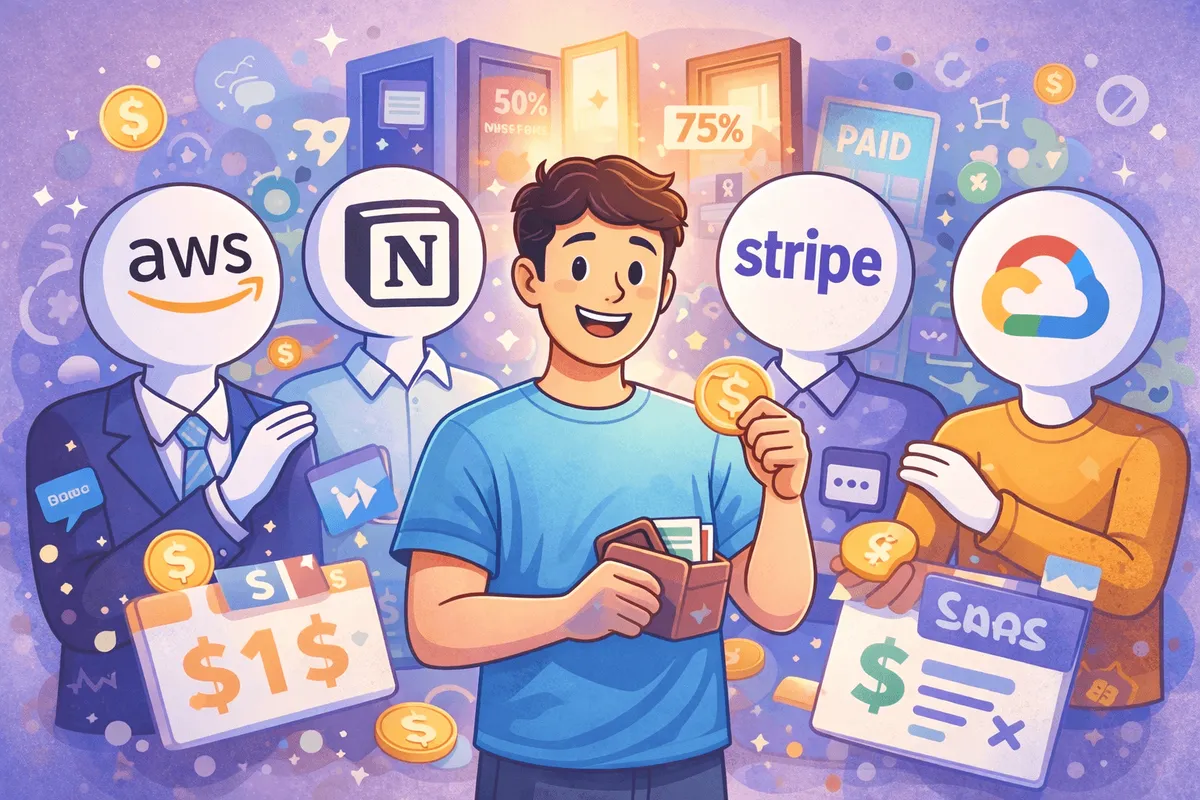
Startup deals are discounts, free tiers, or credits that SaaS companies offer exclusively to early-stage companies.
These startup perks exist to get you hooked early.
They typically come in three forms:
Free credits Cloud platforms like AWS, Google Cloud, and Azure offer credits, often $1,000 to $100,000+, that you can use over 1-2 years. Great for covering your early infrastructure costs.
We now see some LLM providers like Gemini offering credits as well to encourage usage.
We have created a comprehensive guide to $500k+ in free credits from AWS, Google Cloud, Azure, and 40+ other programs.
Free months or years Tools like Notion, Framer, Github and Auth0 offer their paid pro plans free for 6-12 months. Sometimes longer. You get the full product, no restrictions.This can normally cost thousands
Discounts on paid plans Some companies offer 30-90% off, usually on annual plans. Common with CRMs, marketing tools, and sales software like HubSpot, Pipedrive, Brevo and Intercom.
The savings add up fast. A typical early-stage stack could easily cost $2,000-5,000/month at full price. With startup deals, you might pay a fraction of that, or nothing at all for the first year.
Who Qualifies for Startup Deals?
Every program has different requirements to be eligible for these startup subscription deals, but most look for some combination of:
Company age Usually under 2 years old, sometimes under 5. Measured from incorporation date.
Funding stage Many programs are for pre-seed, seed, or Series A companies. Some cut off after you've raised a certain amount (e.g., under $10M raised). Some require previous funding, some do not.
Accelerator or incubator membership Being part of Y Combinator, Techstars, or other accelerators often unlocks exclusive deals, or makes approval easier. Certain startups deals like Plaid credits require you to be a part of an accelerator program, this is their way of de-risking.
New customers only Most deals are for companies that haven't used the paid product before. If you're already a paying customer, you usually don't qualify.
Sometimes they require completely new sign ups as well.
Some programs are more relaxed Not every deal requires funding or accelerator membership. Some just need you to be a registered business under a certain age. Worth checking even if you're bootstrapped.
If you don't qualify for these but you are a student, make sure to check out our guide on student subscription discounts.
Common Deal Eligibility Requirements at a Glance
Requirement | What It Means |
Under 2 years old | From incorporation date |
Under $2-10M raised | Total funding to date |
Accelerator membership | YC, Techstars, etc. |
New customer | Haven't paid for the product before |
Valid business entity | Registered company, not a side project |
Always check the specific terms, they vary by program.
Even bootstrapped startup deals exist, not everything requires VC funding.
Best Startup Deals by Category
Here's a snapshot of what's available. This isn't exhaustive, but it covers the big ones.
Cloud and Infrastructure
Tool | Startup Offer |
AWS Activate | Up to $100,000 in credits |
Google Cloud for Startups | Up to $2000 in credits if haven’t raised, up to $350,000 in credits if raised funding |
Microsoft for Startups | Up to $150,000 in Azure credits |
Gemini LLM API | Up to $300 in credits (Even if haven’t raised) |
Plaid API | Up to $500 a month in credits per API if going through an accelerator |
Vercel | Sometimes credit deals can be found |
Productivity and Collaboration
Tool | Startup Offer |
Notion | Free Plus plan (up to 6 months or longer) |
Slack | 25-50% off paid plans |
Figma | Free Organisation plan for eligible startups |
Framer | 12 months free pro plus plan |
Miro | Free team plan for startups or $1000 in credits |
Developer Tools
Tool | Startup Offer |
Auth0 | Free 12 months enterprise plan |
Stripe Atlas | Fee waivers + partner discounts |
GitHub | Free Team plan for startups |
Make.com | 40% off pro + $10k credits |
CRM and Sales
Tool | Startup Offer |
HubSpot for Startups | Up to 90% off in year one |
Pipedrive | Startup discounts available |
Salesforce | Discounted licenses for startups |
Apollo.io | Startup discounts |
Marketing and Analytics
Tool | Startup Offer |
Amplitude | Free tier + startup program |
Mixpanel | Startup credits available |
Mailchimp | Partner perks through accelerators |
Intercom | Up to 95% off for early-stage |
Hotjar | Startup discounts available |
AI Tools
Tool | Startup Offer |
OpenAI | Startup credits available through programs |
Anthropic | Startup programs emerging |
Jasper | Startup discounts |
Various AI tools | Check aggregators, this space is moving fast |
Note: These offers change frequently. Always verify current terms before applying.
Where to Find Saas Startup Deals
Most startup programs are buried. Here's where to actually find them:
Direct from the Company
Search "[company name] startup program" or "[company name] deals for startups". Many have dedicated landing pages, they're just not linked from the main site.
Deal Aggregators
These sites collect startup deals in one place:
JoinSecret — Popular startup deal aggregator
Founders Pass — Membership-based deal access
SaaS Mantra — Startup-focused deals
Nacho Nacho — Startup deal aggregator focused on alternative tools.
Ramp and others — Some business tools have started adding subscription deals access for their customers.
Quality and freshness of deals varies, but worth checking. Typically they are regularly updated.
Accelerator Perks Pages
If you're in an accelerator, check their deals page:
Y Combinator deals
Techstars perks
500 Global partner offers
On Deck deals
Even if you're not a member, some accelerators publish their deal lists publicly.
The Orbit Deal Finder
We have built a tool that aggregates 725+ deals including startup offers from multiple different sites, all in one place. Add your subscriptions or upload a CSV and the tool will match you to available discounts.
How to Apply for Startup Subscription Discounts
Most startup programs require an application. Here's how to improve your chances:
Have a proper company set up Registered business entity, company email domain, basic website. Looks more legit than a Gmail address and blank LinkedIn.
Apply early Most deals are for early-stage companies. Apply before you raise too much or get too old.
Use your accelerator affiliation If you're part of any program, even a small one, mention it. Some deals auto-approve accelerator members.
Be honest about your stage Don't exaggerate traction or funding. They'll verify, and getting caught means no deal.
Follow up Some applications take weeks, most are pretty fast. A polite follow-up email can speed things up.
Apply to multiple programs Rejected by one? Try another. Different companies have different criteria.
Certain startups deals can also require speaking to a sales rep, we experience this with Plaid notably.
Stacking Multiple Startup Deals
Here's where it gets good: you can stack deals across your entire stack.
A typical startup might combine:
AWS credits for hosting
Notion free for docs
HubSpot 90% off for CRM
Figma free for design
Auth0 credits for authentication
Mixpanel for analytics
Each one is a separate program. There's no rule against using multiple startup deals from different companies.
The key: Apply early, track expiration dates, and have a plan for when the free period ends. This can hit hard if you’re used to paying nothing and have built your organisation around this.
What Happens When Startup Deals Expire?
Most startup deals last 12-24 months. After that:
You convert to a paid plan (usually at a discount for the first renewal)
You downgrade to a free tier if available
You switch to an alternative
Plan ahead. Don't build your entire company on a free tool and then panic when the bill arrives.
Some tips:
Track expiration dates in a spreadsheet or calendar. Or let the Orbit subscription tracker watch them for you.
Evaluate 2-3 months before expiry, do you actually need this tool?
Negotiate directly, sometimes you can extend or get a loyalty discount
Check if you qualify for other discounts (annual billing, non-profit, etc.)
You might be also eligible for discounts if you go to cancel your current subscriptions.
Frequently Asked Questions
Do I need funding to qualify for startup deals?
Not always. Some programs require venture backing, but many are open to bootstrapped companies. Check individual requirements, you might qualify for more than you think.
Can I apply if I'm a solo founder or freelancer?
Some programs are for registered companies only. Others accept solo founders with a side project. It depends on the program. Worth applying, worst case they say no.
There are plenty of other deals to be found that aren’t “startup deals”
What if I'm already paying for a tool?
Most startup deals are for new customers only. If you're already paying, you usually don't qualify. Sometimes you can create a new workspace or account, but read the terms carefully.
How long do startup deals last?
Typically 6-24 months. Cloud credits often have a 12-month expiration. Free plans might last until you hit certain usage thresholds.
Can I use startup deals for my side project?
Depends on the program. Some require a "real" business with incorporation docs. Others are more relaxed. Check the terms before applying.
Are these deals legitimate?
Yes. These are official programs run by the companies themselves. They want to acquire startup customers early, it's a marketing strategy, not a scam.
Quick Wins: Start Saving Today
List your current stack — What are you paying full price for?
Search "[tool] startup program" — Check if they have one
Check deal aggregators — JoinSecret, Founders Pass, our Deal Finder
Apply early — Don't wait until you've raised too much
Stack deals — Use multiple programs across different tools
Track expiration dates — Plan for when free periods end
[Browse startup deals in our Deal Finder →]
Learn more about saving money on subscriptions and SaaS →]
Use Orbit to track smarter, save more, and make your money work for you.